In this blog, Ciara reflects on the films we’ve recently made about our transport to employment work and the impact new services are having on people’s lives.
Growing up in rural Wales, transport was something I rarely thought about until it wasn’t available. As a child, infrequent public transport was something I just accepted, but when I moved away at 18, I quickly realised just how different transport access could be. Suddenly, I was living somewhere buses arrived every seven minutes, instead of relying on a service that might only come once a day.
It was my first real experience of how something many people take for granted can shape opportunities, independence and daily life. I’ve now lived in a city for the last ten years, and my childhood experience of public transport is firmly a memory. But over the last couple of months, I have had the opportunity to work across the SEStran region developing case study films showcasing our Transport to Employment work, and I’ve been reflecting on transport barriers and the impact they have a lot more than usual.
Our Transport to Employment programme is looking to tackle some of the transport barriers that prevent people accessing employment and training opportunities in our region. Working in partnership with local authorities and organisations in our region, we’re looking to make transport improvements that connect more people to opportunities.
On the first day of filming, I made the one-hour bus journey from central Edinburgh to the Edinburgh Royal Infirmary to discuss several new Lothian Bus services that will link Midlothian to this, their local hospital and one of the largest employers in the area. I began to appreciate what a commute could mean for someone – for many people, accepting a job offer is not an easy ‘yes’, and the affordability and accessibility of actually getting to work plays a huge role. And for many, this can be a barrier keeping them from employment.
So far, we have filmed Transport to Employment case studies in Midlothian and the Scottish Borders, and shortly in Clackmannanshire, and I’ve seen the huge impact these new services are having on their local communities. Accounts have been more moving than I expected them to be, with experiences showing how a new or improved service can have an impact that extends well beyond a single journey, opening access to work, education and essential services while also benefiting the wider community.
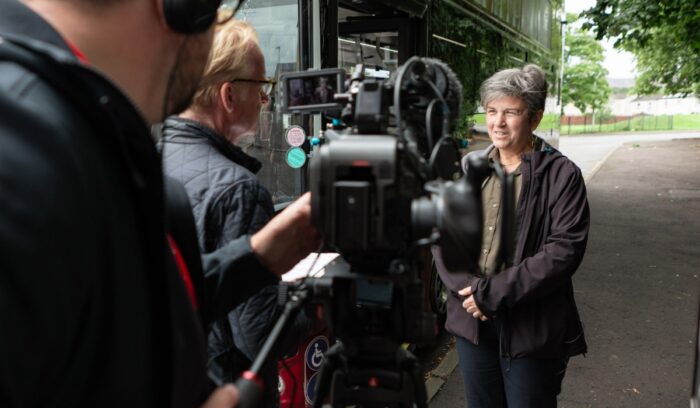 When reflecting on these films, the biggest takeaway for me has been the importance of storytelling. Whilst statistics, charts and numbers are a great way to show success in any project, I think the method of storytelling to show the impact of this work is invaluable. Hearing straight from the people who actually use services talk about how much their lives have been changed by something as simple as a new bus route really highlights the importance of this work. I was surprised to find myself so moved listening to their stories, as well as hearing from the incredible people who have worked tirelessly to make these projects a reality.
The biggest lesson I’ve learned is that transport is far more than simply getting from A to B, and behind every successful project is a person whose world becomes a little bit bigger.