
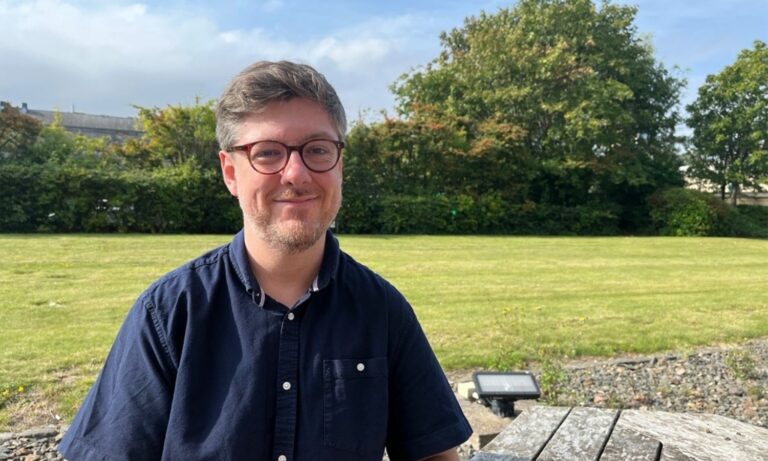
Our November blog is by Project Officer Daniel Moran. In this post, Daniel talks about his move from a parliament role to our regional transport partnership, and the difference between discussing partnership working and making is happen in practice.
I am a recent addition to the SEStran team. For the past twelve years of my professional life I worked in the Scottish Parliament, starting off as a parliamentary researcher and ending as head of office for an MSP.
My work covered a wide range of topics: from planning to the environment, from local government to the economy, from legislative change to transport. Running through all of this, though, was the question of how we could better deliver public services.
I remember over that time, and through many speeches, debates and policy briefings, one recurring phrase whenever reform was discussed: the need for a “joined-up approach to government”. Sometimes this was expressed as an ambition for reform and sometimes as an explanation for why public services were not working as well as they should.
The Christie Commission gave particular force to that idea back in 2011. One of its four pillars for reform was partnership, alongside prevention, people and performance.
I’ve managed to escape politics, to an extent. The ideas that occupied much of my former working life, however, seem to have followed me. I now find myself contemplating what “joined-up government” actually looks like when you move from discussing it in Parliament to trying to make partnership working happen in practice. My change in role has also coincided with a renewed focus from the Scottish Government on an issue being talked about across the public sector and civil society: “public service reform”.
While SEStran, as a Regional Transport Partnership, already operates in a partnership environment, what has been most eye-opening for me in my first few months in the role has been seeing the innovation and collaboration already taking place among the organisations we work with and fund, particularly through our People and Place programme. I have had the opportunity to see first-hand the direct impact that this funding can have, but also to see how communities are developing solutions that might offer lessons for how we achieve more joined-up approaches at scale.
One example that particularly struck me is R2 in North Edinburgh. Rather than organisations working independently alongside one another, R2 brings together a network of community organisations around a shared focus on partnership, knowledge and lasting change for the people of North Edinburgh.
What interests me about the model is not simply that organisations collaborate, but what that collaboration allows them to do. They can share knowledge, work collectively on funding opportunities and make better use of limited resources, while also seeking to influence systems, funding and policy beyond their individual organisations.
Seen through the lens of public service reform, there is something important in that. Some of these principles can sound abstract when discussed nationally: breaking down silos, pooling resources and working towards shared outcomes. Yet they are already being put into practice at community level. There are clear echoes of what the Christie Commission envisaged through its partnership principle.
Partnership is not the only Christie principle I have found myself thinking about. Prevention was another central pillar, and it has been given renewed prominence through the establishment of the Scottish Government’s Prevention Unit.
Here too, there may be lessons from the work already happening through People and Place. Funding active travel behaviour-change programmes is ostensibly transport spending, but its potential benefits do not sit neatly within a transport portfolio. Helping people to walk, wheel or cycle more can support wider objectives around health, the environment and local economies.
That raises an interesting question for preventative spending: if an intervention funded through one policy area can help achieve outcomes across several others, how should we value and invest in it?
It has been heartening to see that innovative solutions and genuine partnership working are already flourishing within the communities we work with. There is much that national and regional organisations can learn from those working at the forefront of community delivery.
Twelve years of hearing calls for “joined-up government” perhaps conditioned me to think of it as something that needed to be created from the top down. My first few months at SEStran have made me wonder whether part of the answer lies in looking in the opposite direction.
If public service reform is to deliver better outcomes for the people who rely on those services, perhaps we should start by learning from the communities and organisations that are already joining things up.
These approaches cannot necessarily be lifted wholesale from a community setting and applied at national scale. But they can offer lessons about what enables organisations to work across boundaries, share resources and focus on common outcomes.